The longest day, so we went
into the mountains to see it through.
The shallows of the river  were dry
as we sat for the feast of Midsummer
on grey sand and shingle and only
the deeps of the river ran swiftly
in a narrow channel in the shade of leaves.
We lingered there till the day was spent,

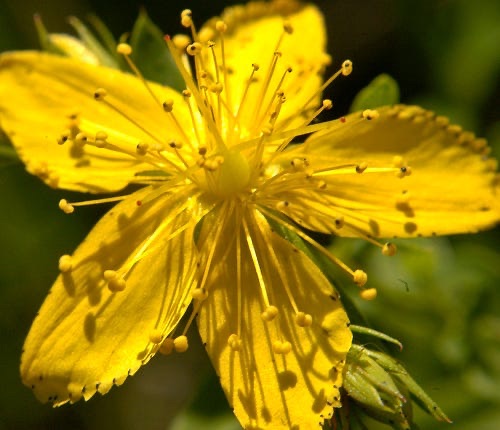
stalking flowers in the grass and found gold:
St John’s Wort or eurinllys* the herball told,
its  leaves adorned  with translucent spots
and petals edged with a beading of dots —
small suns of the mind to hallow the day
and keep from time its passing away.
*Eurinllys (‘golden herb’)
In one of the medieval Welsh herbals Hypericum perforatum is referred to as ‘Eurinllysgadwallawn’, though it’s ‘Eurinllys trydwll’, following the Latin, in modern Welsh usage. Why this herb should have been associated with Cadwallon — presumably the legendary Brythonic chieftain — I have not been able to discover. Certainly the associations of this herb vary between its beneficial link with St John, on whose day (24th June) it is in full flower, and its older link with the Midsummer season which, as Geoffrey Grigson (An Englishman’s Flora, 1958) puts it, “excited the fairies and spirits of the dead” and so became a herb which gave protection against these. Grigson also asserts that its association with St John the Baptist was quite late, though Banckes’ Herball of 1525 calls it ‘Herba Joannis’ and says “the vertue of it is thus. if it be putte in a mannes house there shall come no wycked spryte therein”. By contrast Scot’s The Discoverie of Witchcraft (1584) includes the plant in a charm to raise the ghost of a hanged man.


I was unaware that St John’s Wort was known in Wales as ‘Eurinllysgadwallawn‘ – golden herb of Cadwallon. Thank you for sharing. I wonder if he might have used it for protection against the fairies and spirits of the dead (I’m guessing as a Christian it’s doubtful he’d have wanted to excite them!).
LikeLiked by 1 person